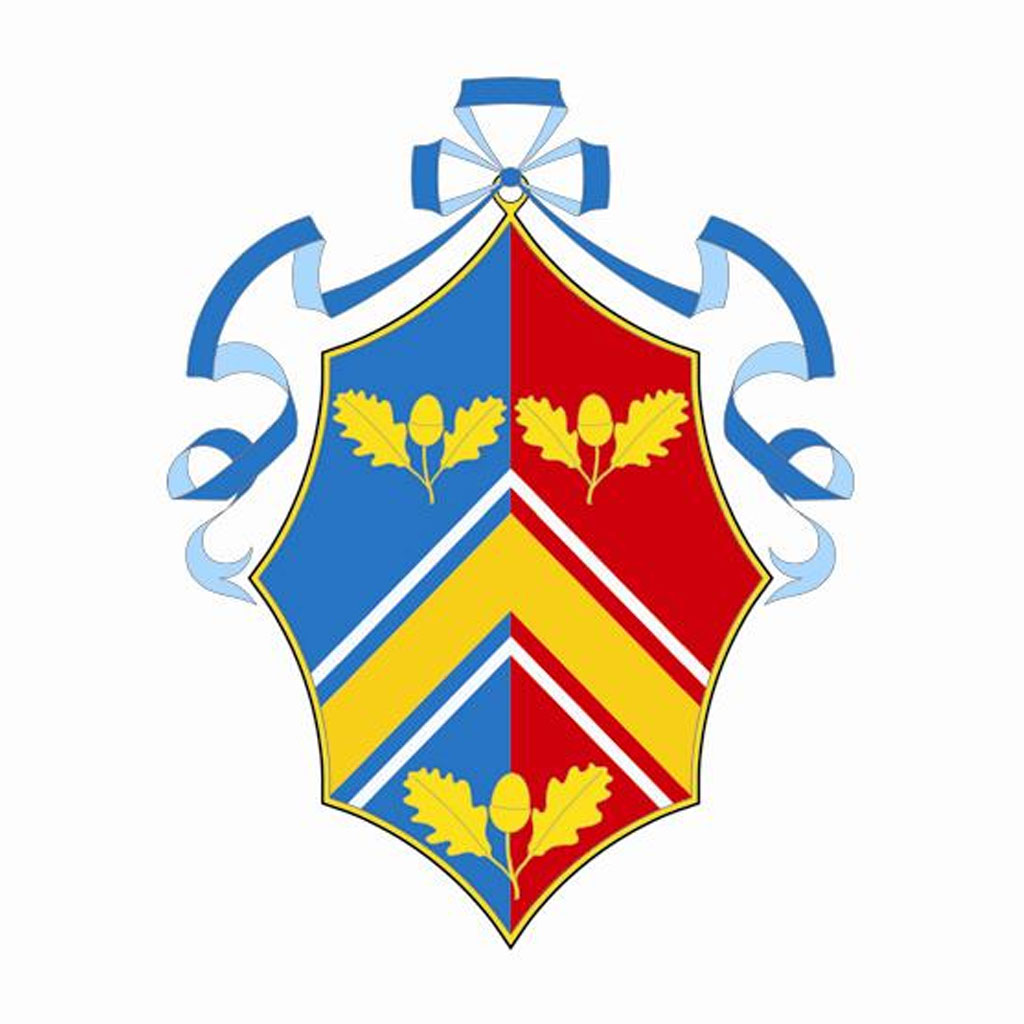
Arms: Per pale Azure and Gules a chevron Or cottised Argent between three acorns slipped and leaved Or.
Her father Michael commissioned the heraldic design to mark his daughter’s marriage to Prince William on 29 April 1911. The design features three acorn sprigs – one for each of the Middletons’ children – an idea she suggested. Royal experts say the coat of arms – which cost £4,400 to make – marks the increased social status of her parents and her potential as a future Queen. Thomas Woodcock, Garter Principal King of Arms, from the College of Arms in the City of London, helped the Middletons with the design. He said the oak tree was a traditional symbol of England and a feature of west Berkshire, where the family have lived for 30 years. Mr. Woodcock said the gold chevron in the centre of the coat of arms signified Miss Middleton’s mother, Carole, whose maiden name was Goldsmith. White chevronels – narrow chevrons above and below the gold chevron – symbolise peaks and mountains, and the Middleton family’s love of the Lake District and skiing. Mr. Woodcock said: “It’s not compulsory, but as their daughter is marrying into the Royal Family she will have a need probably to use a coat of arms.”
Coats of Arms for “eminent subjects of the crown cost £4,200 (you get a vellum scroll)”, quotation of Peter Hunt, BBC Royal correspondent. He said Miss Middleton could have been granted her own heraldic design but her father wanted the whole family to be able to use it. This version of the coat of arms, an elaborate lozenge, which can only be used by Kate or her sister Pippa as it denotes a Middleton spinster, will be printed on the back of the souvenir programme. Prince William’s will be on the front. Miss Middleton’s heraldic design features a tied ribbon to show she is an unmarried woman. Overall, it is designed like an elaborate lozenge rather than a shield, a shape reserved for men. She will be able to use the coat of arms up until her wedding day, after which it will be combined with that of Prince William. Mr. Woodcock said: “With any new design of a coat of arms you have to make sure that the design is distinct not just in colour but in the linear appearance. “And, as there is a 16th century coat of arms with a chevron between three sprigs of oak, we’ve made the differences – dividing the background colours.”
Adapted from the BBC UK article on the subject dated 19 April 2011. dqw 20110422
The artwork is a rendering by John Hamilton Gaylor.
Wedvick Armorial, 200, Middleton, 20110422
AAA Preface
Introduction
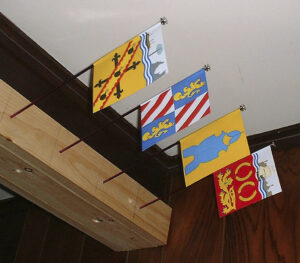
For some years we have desired to have and build our own armorial. In mid 2007, the opportunity arose where an heraldic artist agreed to work with me to create the shields we desired and to create masters for table banners