St. Brigitta of Sweden
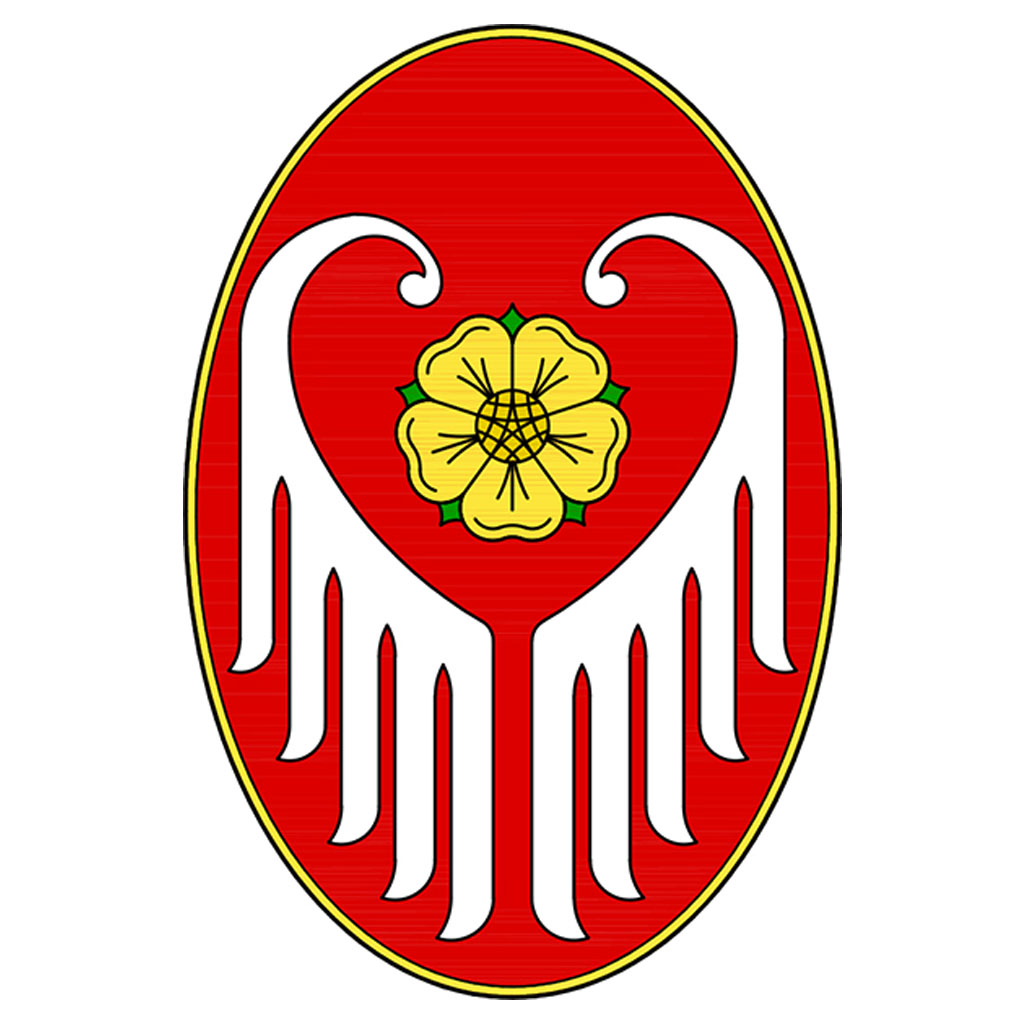
Arms: Gules a rose Or between two eagles’ wings Argent.
The shape of the wings is unique, but is copied from the late 13th century (1296) seal of her father, Birger Persson of Finsta, one of the great Swedish nobles of the day.
SOURCE/NOTES & CREDITS: The arms of St. Brigitta’s depicted are those of her father Briger Persson of Finsta. The arms of Birger Persson are from his seal on page 433 of the article “Birgittinsk ordensheraldik” by Bengt Olof Kälde found in “Heraldisk Tidsskrift, Volume 3, No. 29, March 1974. Also his arms are depicted on his gravestone shown and discussed on pages 17 & 18 of “Svensk Heraldik” by Berhard Schlegel and Carl Arvid Klingspor, W. Schultz, Upsala 1874.
Only the real biggies ( magnates ) had arms in those days in Sweden. St. Brigitta, born Brigitta Birgersdatter of Finsta in 1303 had royal Swedish ancestry from both parents and died in 1373. She was the daughter to Birger Persson of Finsta, a high and important Swedish noble of great wealth and Lawgiver of Upland. She married Ulf Gudmarsson of Ulfåsa, in 1316 later Lawgiver of Närke.
She became an advisor to her King and later to popes, founded an order of nuns and administered the hundreds of farms and properties she inherited. Somehow through all of this she lived in the odor of sanctity which was manifest, palpably, to her followers, companions and contemporaries. Much has been written about her and much of what she had to say has been written down also.
Most recently, she was made the Patron Saint of Europe in 1999 by Pope John Paul II.
St. Brigitta is known today for the passing on of the devotion of The Seven Sorrows.
The artwork is a rendering by John Hamilton Gaylor.
2018 1215
dqw266@gmail.com