Blazon of Arms:
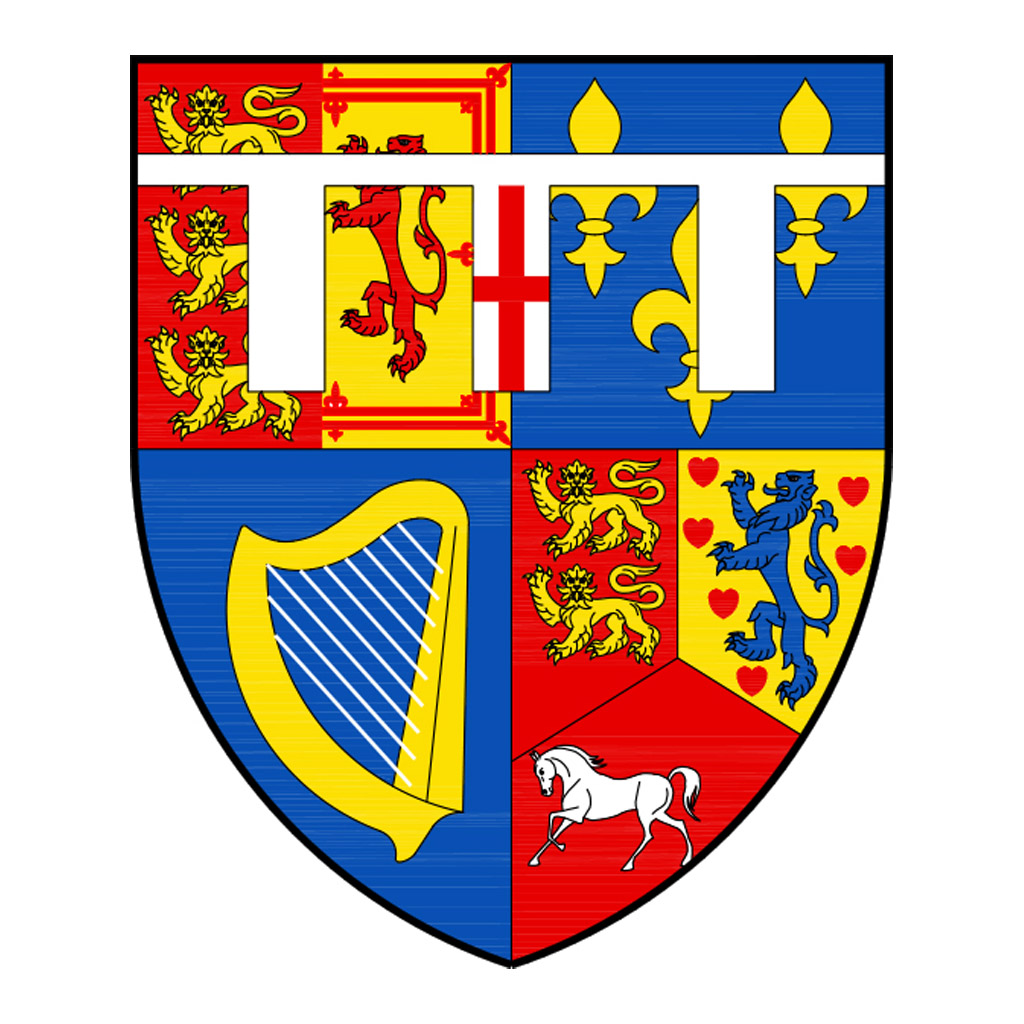
Shield: Quarterly, 1st grand quarter two coats impaled, dexter Gules three lions passant gardant in pale Or (for England), sinister Or a lion rampant within a double tressure flory counterflory Gules (for Scotland);
2nd grand quarter Azure three fleurs de lis Or (for France);
3rd grand quarter Azure a harp Or stringed Argent (for Ireland);
4th grand quarter tierced in pairle reversed 1st Gules two lions passant gardant in pale Or (for Brunswick), 2nd Or a lion rampant Azure amid a half dozen of hearts Gules (for Lüneburg), in base Gules a horse passant at pace Argent (for Hanover); over all for difference a label of three lappets Argent charged on the middle lappet with a cross Gules.
SOURCES, NOTES & CREDITS: The illustration for background and the text are adapted from the Wikipedia article. John Gaylor wrote the blazon for us for which we thank him. Note to the blazon: that the lions passant are gardant (looking around) not guardant (keeping watch).
Prince William Augustus, Duke of Cumberland (15 April 1721 – 31 October 1765), was the third and youngest son of George II of Great Britain and Ireland and his wife, Caroline of Ansbach. He was Duke of Cumberland from 1726.
He is best remembered for his role in putting down the Jacobite Rising at the Battle of Culloden in 1746, which made him popular in certain parts of Britain. He is often referred to by the nickname given to him by his Tory opponents: ‘Butcher’ Cumberland.
Arriving in Edinburgh on 30 January 1746, Cumberland assumed command of his forces and marched them to Aberdeen. There, he ordered them to undergo training for approximately two months in preparation for engaging the Jacobite Army. On 8 April, he set out from Aberdeen with his troops for Inverness; eight days later on 16 April, he engaged the main Jacobite army near the village of Culloden. In the ensuing battle, his army decisively defeated the Jacobites. The battle lasted only an hour, with the Jacobites suffering between 1,500 and 2,000 casualties, while approximately 300 government soldiers were killed or wounded.
On the morning after the battle, Cumberland issued a written order reminding his men that “the public orders of the rebels yesterday was to give us no quarter” and ordering his men to treat Jacobite wounded in the same manner. Cumberland alluded to the belief that such orders had been found upon the bodies of fallen Jacobites. However, for the two days after the battle, Cumberland’s order was not followed upon; though in the following two days, government troops scoured the battlefield and put to death many wounded Jacobite soldiers they came across.
Government forces subsequently embarked upon the pacification of Jacobite regions in the Scottish Highlands, which took several months. They carried out searches for rebels across the Highlands, confiscating property, destroying nonjuring Episcopalian and Catholic meeting houses and summarily executing numerous suspected rebels. While he had been in Inverness, Cumberland emptied the city jails of all of those who had been imprisoned by Jacobites and replaced them with Jacobites themselves; after the battle at Culloden, Jacobite prisoners were taken south to England to stand trial for high treason.
Butcher Cumberland Following Culloden, Cumberland was nicknamed “Sweet William” by his Whig supporters and “The Butcher” by his Tory opponents.
He died on 13 October 1765 at age 44.
The artwork is an interpretation of John Hamilton Gaylor.
2025 0909
dqw266@gmail.com