
Count Eric von Rosen
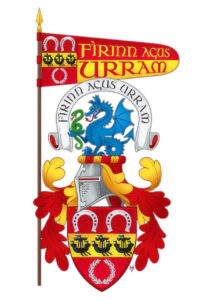
ARMS: Or three roses Gules
SOURCE/NOTES & CREDITS: Blazon: translation by D.Q. Wedvick from the Swedish from “Den Svenska Adelns Vapenbok”, by Dahlby & Raneke, Albert Bonniers Förlag, Stockholm, 1967, page 180. Background illustration: Page 611, “Sveriges Adels Kalender”, 2001. Text: by D.Q. Wedvick adapted from: “Military Pilot & Aircrew Badges of the World” ( 1870-Present ) Vol. 1, Europe ( Albania-Hungary ), by Don Chalif, R. James Bender Publishing, San Jose, 1982, Page 95, “Sveriges Adels Kalender”, 1922, Page 992 & 1950, page 815, the Wikipedia internet article and from private correspondence with Henrik Degerman, former genealogist to Finland’s House of Nobles.
Count (greve) Eric Carl Gustaf Bloomfield von Rosen, born 2 June 1879, Swedish landowner, married in 1905 Baroness ( friherrinnan ) Mary Fock with whom he had six children. The von Rosen family was of Baltic noble origin (Estonia and Latvia), naturalized as untitled Swedish nobles in 1726 raised to baronial status in 1731 and introduced in the same year. A branch of this family was raised to countly status in 1751 and introduced in 1752, ( which meant that all descendants of this branch were (are) counts and countesses). He was an ethnologist, author and philanthropist who traveled extensively in Lapland, South America and Africa before WW1 using his considerable wealth to advance research and studies in cultures outside Europe.
He was the Swedish nobleman who gave the newly independent country of Finland an aeroplane with which to start its Air Force on 6 March 1918. The aircraft, a license manufactured Morane-Saulnier MS Parasol/Thulin D, was marked with his badge, a blue swastika on a white background. The Finnish Air Force adopted this as their national insignia. This had no connection to the later nazi black crooked swastika, but was adopted by Finland in black and used square ( sides vertical, top & bottom horizontal ) on a blue background on pilot badges and I believe in various colours and backgrounds on airplanes, military vehicles, and in medals and decorations. ) Eric von Rosen had been using a swastika as a personal owner’s mark for many years. He originally saw the symbol on runestones in Gotland, while at school. Knowing that the symbol signified good luck for the Vikings, he utilized the symbol and had it carved into all his luggage when going on an expedition to South America in 1901. The swastika has not been used on Finnish planes since WW2
Von Rosen was also to become brother-in-law to Hermann Göring, when his wife’s sister, Carin von Kantzow (nee Fock), married Göring. Everything had started when Göring was flying Eric von Rosen in bad weather from Stockholm to Rockelstad, his castle at lake Båven in Sörmland, Sweden. Due to bad weather conditions, Göring had to stay at the castle. There he became acquainted with the sister of von Rosen’s wife, Carin von Kantzow. She was at that time married to a Swedish officer, but would be Göring’s big love and future wife. Göring had noted the swastika during his stay in Sweden at von Rosen’s castle (forged into a metal piece at the fireplace). However, the swastika of the German Nazi party had been adopted already in 1920, two years before Göring met Adolf Hitler.
The artwork is a rendering by John Hamilton Gaylor.
Wedvick Armorial, 139a, Rosen, von, 20100419