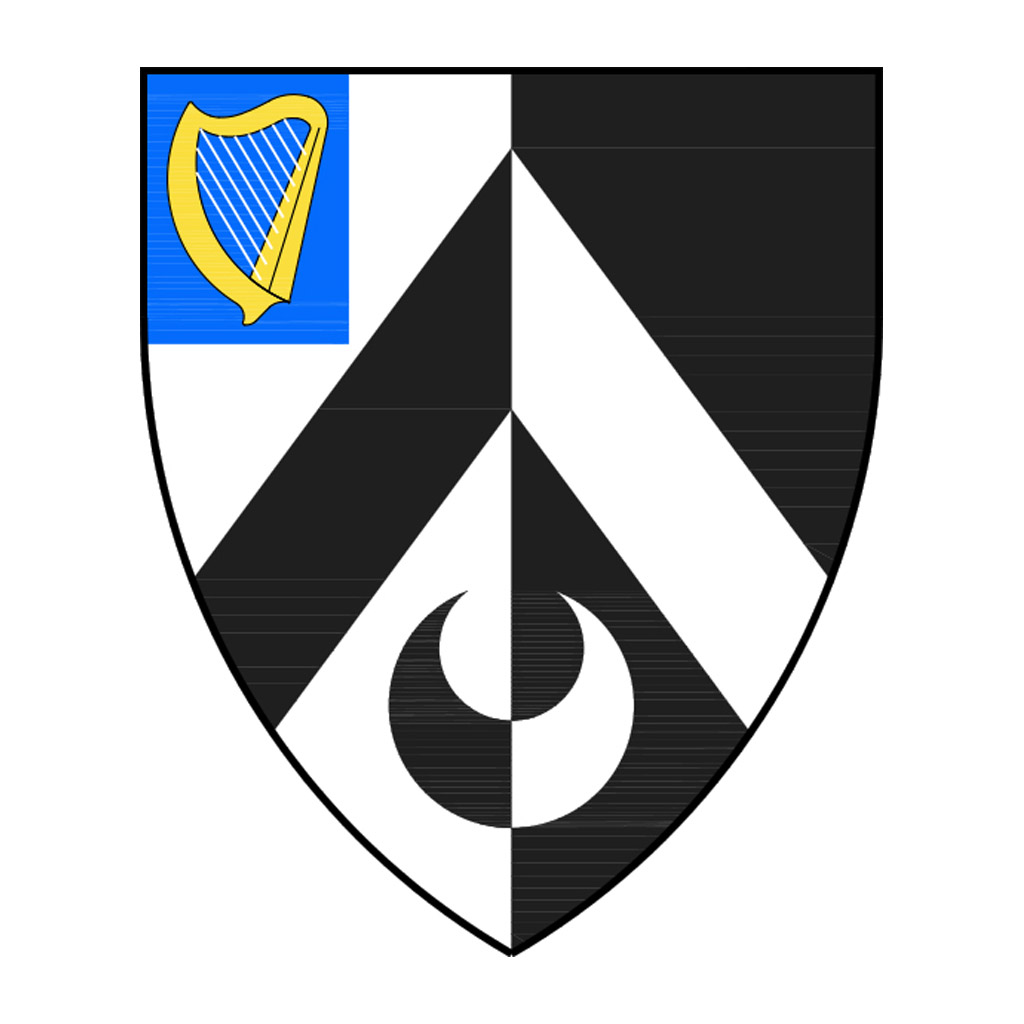
Arms Per pale argent and sable a chevron and in base a crescent all counterchanged on a canton azure a harp or stringed argent.
SOURCES, NOTES & CREDITS: Illustration for background and text from Wikipedia.
Field Marshal Harold Rupert Leofric George Alexander, 1st Earl Alexander of Tunis KG, GCB, OM, GCMG, CSI, DSO, MC, CD, PC (Can), PC was a senior British Army officer who served with distinction in both the WW1 & WW2, and afterwards, as Governor General of Canada, the 17th since the Canadian Confederation.
Alexander was born on 10 Dec 1891 in London to aristocratic parents and was educated at Harrow before entering the Royal Military College, Sandhurst, for training as an army officer of the Irish Guards. He rose to prominence through his service and gallantry in the First World War, receiving numerous honours and decorations, and continued his military career through various British campaigns across Europe and Asia.
In World War II, Alexander oversaw the final stages of the Allied evacuation from Dunkirk and subsequently held high-ranking field commands in Burma, North Africa and Italy, including serving as Commander-in-Chief Middle East and commanding the 18th Army Group in Tunisia. He then commanded the 15th Army Group for the capture of Sicily and again in Italy before receiving his field marshal’s baton and being made Supreme Allied Commander Mediterranean.
In 1946 he was appointed as governor general by King George VI, on the recommendation of Prime Minister of Canada William Lyon Mackenzie King, to replace the Earl of Athlone as viceroy, and he occupied the post until succeeded by Vincent Massey in 1952. Alexander proved to be enthusiastic about the Canadian wilderness and was a popular governor general with Canadians. He was the last non-Canadian-born governor general before the appointment of Adrienne Clarkson in 1999, as well as the last governor general to be a peer.
After the end of his viceregal tenure, Alexander was sworn into the Queen’s Privy Council for Canada and thereafter, in order to serve as the British Minister of Defence in the Cabinet of Winston Churchill, into the Imperial Privy Council. Alexander retired in 1954 and died on 16 June 1969.
The artwork is an interpretation of John Hamilton Gaylor
2020 1027
dqw266@gmail.com