Dr. Patrick Barden, Dr Med Vet, Fellow HSS (1934-2001)
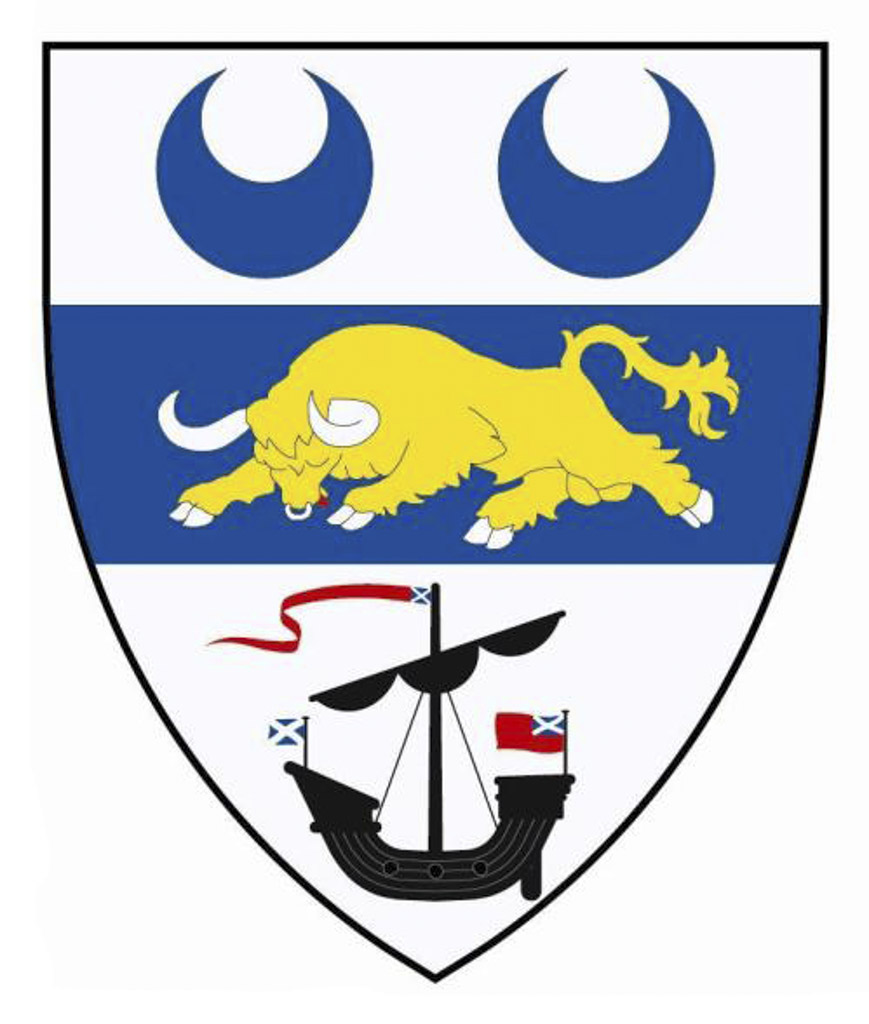
Arms: Argent on a fess between two crescents in chief Azure and a lymphad sails furled Sable in base a highland bull charging Or armed unguled and ringed Argent
SOURCE, NOTES & CREDITS: Blazon for arms from J. H. Gaylor, background illustration from Page 18, “Scottish Heraldry an Invitation”, by M.D. Dennis, 2nd Edition, Edinburgh, 2002. Text adapted by D.Q. Wedvick from “Memorial – Patrick John Barden” by Gordon Casely, page 7, “The Double Tressure”, No. 24, 2001.
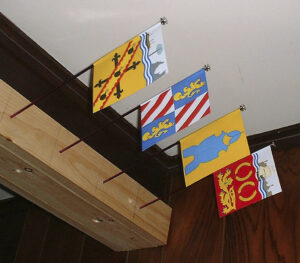
Parick John Barden born in 1934 presented an enigma: born and educated in Eastborne of English parents, he spoke English in a Scots voice, and was fluent in six languages including Gaelic. His interest in heraldry began at age nine, and thereafter he collected and drew coats of arms wherever he was. As a veterinarian he worked for a number of international companies and while at Ciba-Geigy he shared a laboratory block with a paint scientist, with whose help, he secured a breakthrough which enabled him to apply airbrushed waterproof paint to lightweight fabric. Thus he had invented a sturdy flag which nevertheless could fly in the merest of zephyrs. At age 54 he gave up everything to return to Scotland as an heraldic flagmaker and designer setting up a studio in Alloa. His first major commissions were in 1981 for Dunfermline Abbey and the Palace of Holyroodhouse where his work immediately caught the eye of the discerning. His clients included royalty, clan chiefs, councils, and corporations. Barden’s flags burst forth in full and accurate colours for every occasion – royal banners, national banners, society banners, personal banners, funeral banners, pipe banners, street banners, and parade banners as well as standards, guidons and gonfannons all meticulously correct in every heraldic detail. His flags and hangings adorn many distinguished venues and his incredible output ensured that banners in the distinctive Barden style are used daily.
He was also a former Chairman and Editor of the Heraldry Society of Scotland where he proved a charismatic leader and generously provided many banners for Society use. Dr. Barden died suddenly at his home at Rumbling Bridge in July 2001 just 4 days shy of his 67th birthday. His work ensures him a special place in Scots heraldry of the late 20th and early 21st centuries. dqw 2012 1103
The artwork is a rendering by John Hamilton Gaylor
Wedvick Armorial, 162, Barden, 2012 1103