
Arms:
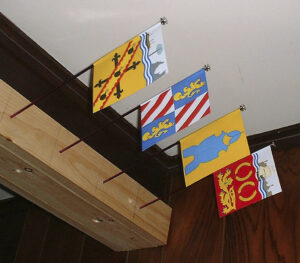
1st quarterly ermine and gules, ( for Stanhope ),
2nd argent a cross formy fitchy at the foot sable, for Wotton ( for Marley, county Kent ),
3rd azure ten billets 4, 3, 2 and 1 or on a chief of the last a demi lion rampant issuant sable, ( for Dormer ),
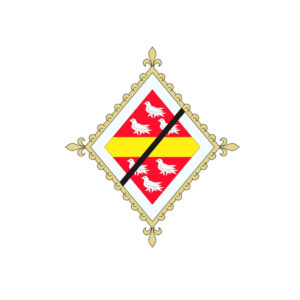
4th argent on a bend sable three owls gardant of the field, ( for Savile [Thornhill, county York] ).
SOURCE, NOTES and CREDITS: arms, BGA, page 961, column 1; Illustration for background: Wikipedia article, blazon John Hamilton Gaylor. Text: from “The New Extinct Peerage, L.G. Pine, pp 65-68 and especially the Wikipedia article.
Sir Philip Dormer Stanhope, 4th Earl of Chesterfield, KG, was born on 22 September 1694 in London, educated in Cambridge and did the “Grand Tour of the continent. With the accession of George I, he went into politics first in the Commons and in 1726, Lords.
Considerably more of his biography is to be found in his Stanhope entry in the Wedvick Armorial album in this website.
While he is most famous for his “Letters to his Son”, it is the other interesting aspects and legacy remainders of this remarkable lord of which we treat here.
During his assignment as Lord-Lieutenant of Ireland 1745-46, he got rid of corruption traditional to the office and went on to establish schools and factories. He was the first Lord-Lieutenant to allow Dubliners to roam in the Phoenix Park, installed the “Phoenix Monument”, a phoenix bird on a Corinthian column, extant yet, the 2.8 mile main drive through the park is still known as Chesterfield Avenue.
He worked well with and pacified both the Protestant Orange Party and the Roman Catholic Pro-Jacobite group with the result the Irish Jacobites did not support the Jacobite rising of 1745-1746 in Scotland and England.
It has been said, upon being roused for a false alarm of an Irish rebellion and being told that “the papists in Ireland are all up!”, he replied: “I am not surprised at it, why, it is ten o’clock, I should have been up too, had I not overslept myself.”
He then served as Secretary of State ( Northern Secretary ) 1746-48 and then declined a dukedom from George II around 1750 and retired.
His legacy: Lord Chesterfield appears as a character in the novel The Virginians (1857), by William Makepeace Thackeray.
Chesterfield is mentioned in the novel Barnaby Rudge: A Tale of the Riots of Eighty (1841), by Charles Dickens, wherein the foppish Sir John Chester says that Lord Chesterfield is the finest English writer: “Shakespeare was undoubtedly very fine in his way; Milton good, though prosy; Lord Bacon deep, and decidedly knowing; but the writer who should be his country’s pride, is my Lord Chesterfield.”
In the UK, the 4th Earl of Chesterfield gave his name to Chesterfield Street, Mayfair, London, which runs from Curzon Street to the site of the former Chesterfield House.
And in the US, his name has been given to Chesterfield County, Virginia and Chesterfield County, South Carolina.
The first leather “chesterfield” sofa, with its distinctive deep buttoned, quilted leather upholstery and lower seat base, is believed to have been commissioned by the 4th Earl of Chesterfield. Consequently, in the UK, the word “chesterfield” now describes a deep buttoned sofa, usually, but not always, made from leather, with arms and back of the same height.
In the US and Canada, “chesterfield” used to be the prevalent term for any type of couch, but, has been decreasing in popularity in recent years.
Chesterfield Cigarettes were named after Chesterfield County, Virginia, which was itself named for the 4th Earl of Chesterfield.
Chesterfield coats, for both men and women, are woolen overcoats with velvet on the collar, an elegant touch was a fashion started by the famous 4th Earl of Chesterfield.
Lord Chesterfield Ale, made by DG Yuengling &Son, Inc. Of Pottsville, Pennsylvania USA is named after the 4th Earl.
Lord Chesterfield exercised a mordant wit, as in his celebrated description of sexual intercourse; “the posture ridiculous, the pleasure transient and the price damnable”.
Philip Stanhope, 4th Earl of Chesterfield, died on 24 March 1773, age 79.
The artwork is an interpretation by John Hamilton Gaylor
2020 1117
dqw266@gmail.com