Hunter
David Hunter of Montlaw
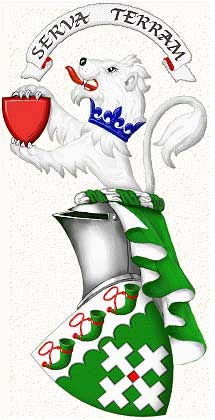
Arms: Vert a cross-crosslet Argent square-pierced Gules on a chief engrailed Argent three hunting horns Vert stringed and viroled Gules
Crest: a demi-lion rampant Argent gorged of a coronet of four fleurs-de-lis (one and two halves visible) Azure, holding betweein his paws an escutcheon Gules,
Motto: SERVA TERRAM
Matriculation: Court of the Lord Lyon, 27th July 1993. Lyon Register, Vol. 73, folio 116.
Obituary David Hunter of Montlaw: American lawyer and scholar of mediaeval Scottish heraldic texts
Published Date: 16 January 2009
By GORDON CASELY
Born: 15 June, 1963, in Ancortes, Washington State. Died: 21 December, 2008, in Olympia, Washington State, aged 45.
DAVID Hunter of Montlaw was a US lawyer whose avocation was the researching of old Scottish grants and matriculations of coats-of-arms, and who, as a heraldist, became known for his expertise on mediaeval Scottish arms. He was a type 1 diabetic, and his death at home was as sudden as it was unexpected.
Montlaw was a classic example of an American long descended from a Scot whose passion for the old country exceeded that of any born Scot – except that he achieved his end in a quiet, scholarly manner. Great-great-grandson of an Angus ancestor born in Brechin in 1836, Montlaw was a proud and active member of his clan.
Born Paul David Hovey, he adopted his mother’s maiden name and somewhat mischievously assumed the territorial title “of Montlaw”. He wouldn’t have got away with the latter in Scotland under the writ of Lyon Court, but in the New World they turn a Nelson eye.
Montlaw matriculated his arms in 1993 from a maternal grandfather in British Columbia, flying his own banner at clan gatherings in the US and participating in congresses. He was a staff lawyer and sometime court commissioner for Thurston County Superior Court in Washington State, and the extent of his heraldic research ran to several publications as well as gracing the website of the Heraldry Society of Scotland.
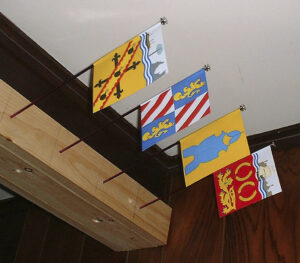
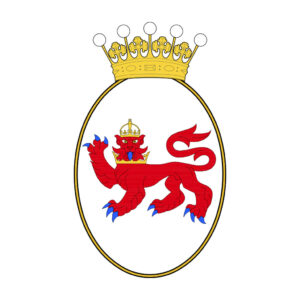
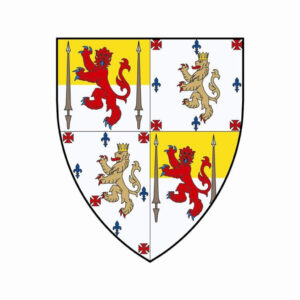
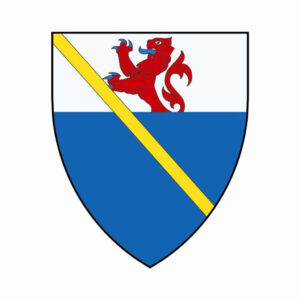
He took pride in membership of clan Hunter, and recently presented weatherproof banners for display at gatherings in North America depicting 34 of the 37 variants of Hunter arms, with the heraldry of his chief, Pauline, Madam Hunter of Hunterston, in prime position. At the time of his death, he had been working on a Hunter armorial, gathering information on as many of the name as he could find.
Montlaw was a long-standing member of the Heraldry Society of Scotland, as well as supporting other heraldic groups throughout the world, notably the Royal Heraldry Society of Canada. A member of the (English) Heraldry Society for many years, he passed the society’s heraldic examinations with credit at a young age. His attendance at heraldic congresses was a sure sign that a creatively worked paper was to be presented in academic, though never dry, fashion. He was due to attend the AGM of the Heraldry Society of Scotland in Perth in May.
With his compatriot Leslie Schweitzer, he produced An Annotated Bibliography of Scottish Heraldic Materials, recognised as invaluable and as near complete a record as anything so far produced. The bibliography discusses various sources of information on Scots heraldry generated at home and abroad.
A craftsman of some ability, he produced heraldic display work in a variety of media, showing particular skill in using the technique known as opus Anglicanum, a form of English embroidery in fine goldwork and skilful use of underside couching and silk floss split stitch.
He presented several heraldic table banners to friends at the heraldic congress in St Andrews in 2006, each item individually embroidered complete with diapering.
Montlaw achieved licence status to practise as a lawyer in the US in 1989, and advertised himself as a “specialist in researching ancient Scottish patents and matriculations”.
Tall, bearded and immensely sociable, he was described by an American friend as able to “argue a contrary point of view and never make you feel he was contradicting you for contradiction’s sake. He added: “He was one of the whetstones we sharpened our minds against. Helped, of course, that he was right more often than wrong.
“But perhaps a more defining mark was how he did every doggoned thing he tried superbly, as a matter of fact. It seemed almost unfair, the way he was so accomplished and made it look so easy. For him, it seemed as automatic as breathing air.”