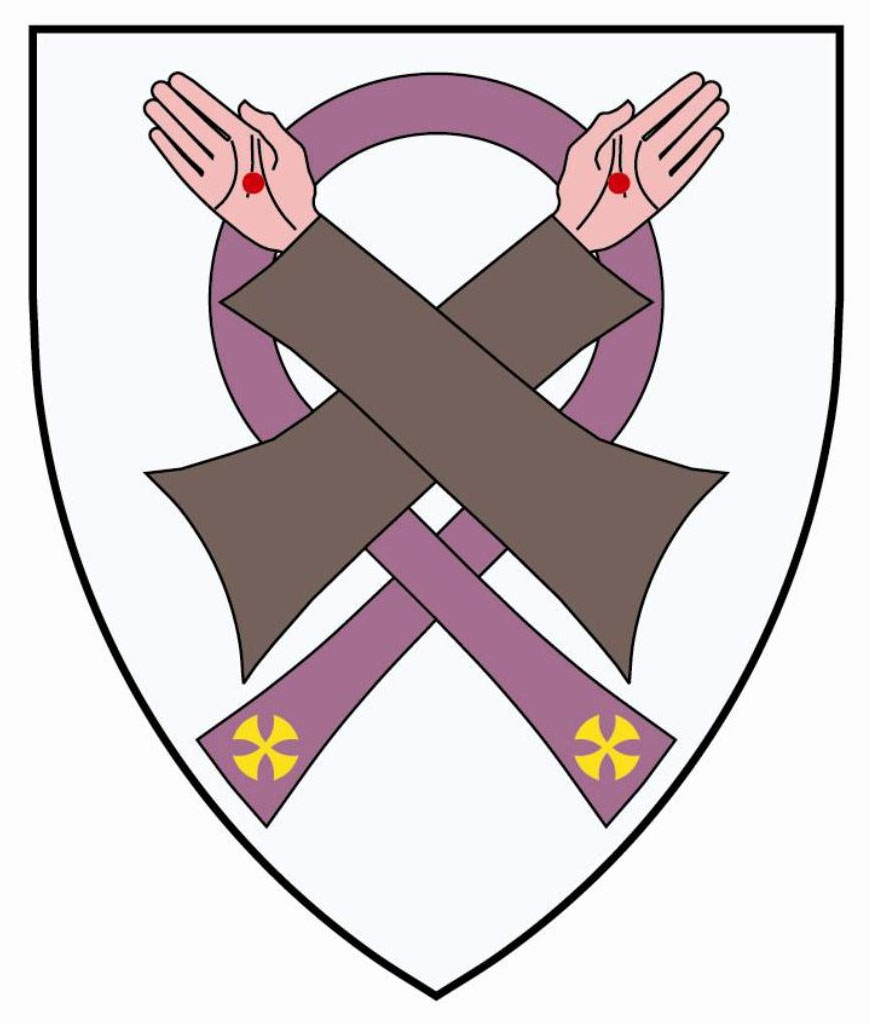
Blazon: Argent a priestly stole its ends crossed in saltire purpure charged at each end with a cross paty or, overall, two arms couped appaumée in saltire with stigmata on the palms and vested in the sleeves of a Franciscan habit proper.
SOURCES, NOTES & CREDITS: We have here arms of admiration created for one of the great saints of the twentieth century, St. Pio of Pietrelcina. His parents were peasant farmers and of course wouldn’t have had arms of their own. These arms were created and illustrated by John Hamilton Gaylor for which we thank him. The text was adapted from the Wikipedia article and from the book “Blessed Padre Pio”, The friar of San Giovanni, by John McCaffery, an Irish journalist in 1978, published by Roman Catholic Books, Fort Collins, Co.
Francesco Forgione was born to Grazio Mario Forgione (1860–1946) and Maria Giuseppa Di Nunzio (1859–1929) on May 25, 1887, in Pietrelcina, a town in the province of Benevento, in the Southern Italian region of Campania. His parents were peasant farmers.
Saint Pio of Pietrelcina, widely known as Padre Pio, was an Italian Capuchin friar, priest, stigmatist, and mystic. He is venerated as a saint in the Catholic Church, with his feast day celebrated on 23 September. Francesco’s father went to the United States in search of work to pay for private tutoring for his son, to meet the academic requirements to enter the Capuchin Order. On 6 January 1903, at the age of 15, he entered the novitiate of the Capuchin friars at Morcone. On 22 January, he took the Franciscan habit and the name of Fra (Friar) Pio, spent most of his religious life in the convent of San Giovanni Rotondo.
He commenced a seven-year study for the priesthood, for which Pio travelled to the friary of Saint Francis of Assisi in Umbria. In August 1910, Pio was ordained a priest by Archbishop Paolo Schinosi at the Cathedral of Benevento. He was marked by stigmata in 1918, leading to several investigations by the Holy See. In the next months, his reputation of sainthood grew rapidly in the region of San Giovanni Rotondo, attracting hundreds of believers at the monastery coming each day to see him.
People who had started rebuilding their lives after WW1 began to see in Pio a symbol of hope. Those close to him attest that he began to manifest several spiritual gifts, including the gifts of healing, bilocation, levitation, prophecy, miracles, extraordinary abstinence from both sleep and nourishment.
For the next forty-nine years struggled with Vatican investigations and restrictions but none of them stopped or deterred him from being and extraordinary priest. His chief occupation was that of a priest confessor. Padre Pio died on 23 Sep 1968 at age 81. On 26 Sep his funeral was held with 100,000 people attending. After a funeral procession in San Giovanni Rotondo and the funeral Mass, his body was buried in the crypt in the Church of Our Lady of Grace.
Padre Pio’s cause for beatification and sainthood was opened in 1982. In 1990 Padre Pio was declared a Servant of God. In 1997 Pope John Paul II declared him Venerable.
In 1999 John Paul II declared Padre Pio Blessed and set 23 September as the date of his liturgical feast. The Mass for his beatification was celebrated on 2 May 1999 by John Paul II on St. Peter’s Square in Rome, with more than 300,000 faithful attending the ceremony. In his homily, John Paul II mentioned Padre Pio’s stigmata and his mystical gifts.
After further consideration of Padre Pio’s virtues and ability to do good even after his death, John Paul II promulgated the decree of canonization on 28 February 2002. The Mass for the canonization was celebrated by John Paul II on 16 June 2002 at St. Peter’s Square in Rome, with again an estimated 300,000 people attending the ceremony.
We believe it is safe to say that St. Padre Pio was one of the twentieth century’s greatest saints.
The artwork is an interpretation of John Hamilton Gaylor.
2025 0826
dqw266@gmail.com