Achille Ratti, Pope Pius XI
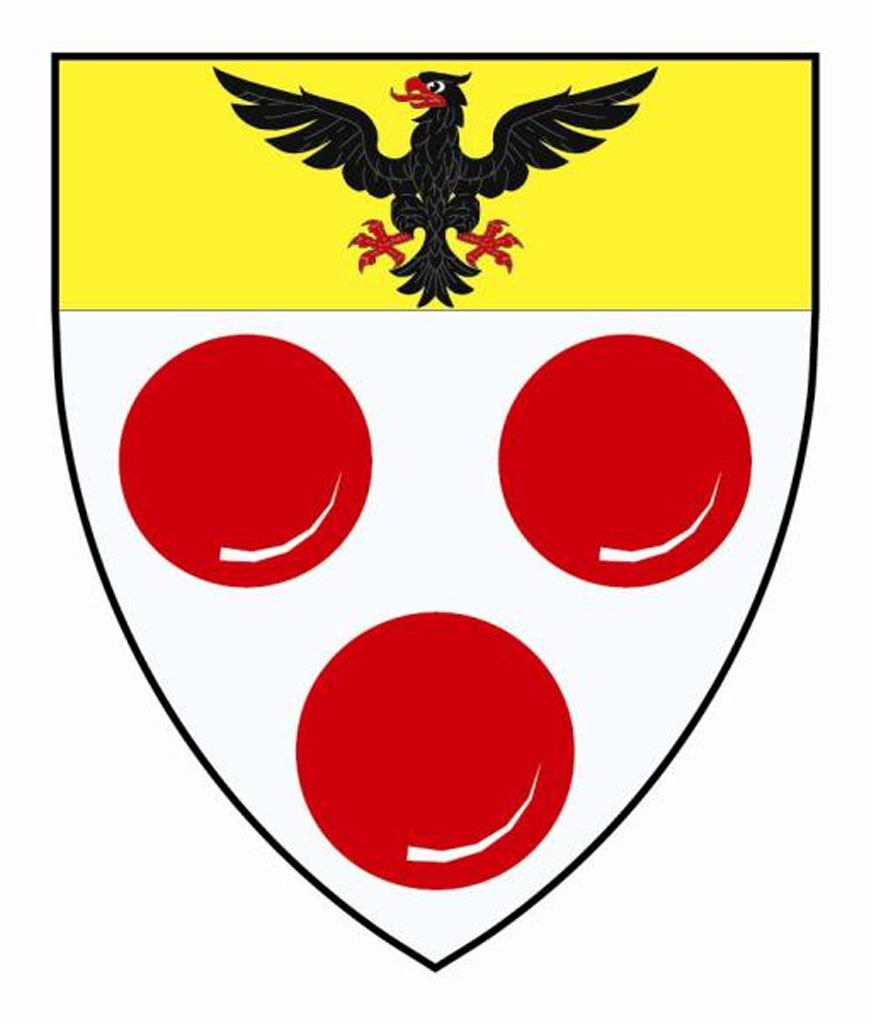
Arms: Argent three torteaux Gules and on a chief Or an eagle displayed Sable armed Gules
SOURCE/NOTES & CREDITS: Source of Blazon, page 213, and illustration for background, Plate XX, from “ Heraldry in the Vatican” Card. Jacques Martin, Van Duren, Gerrards Cross, Buckinghamshire, 1987. The blazon was reworked by J.H. Gaylor. Text by D.Q. Wedvick adapted from his article, “Heraldry, Part 2, the heraldry and history of six pontiffs before and after St. Pius X”, in the August 2008 issue, Number 8, Volume XXXI, “The Angelus”, a monthly journal of Roman Catholic Tradition, SSPX.
Ambrogio Damiano Achille Ratti was born on 13 May 1857 to a family armigerous since the thirteenth century and was the son of a prosperous silk factory owner in Desio, Milan. Ordained a priest in 1879, he earned triple doctorates in philosophy, canon law and theology and proceeded to work as a scholar ( in libraries and museums ) for decades ! As a hobby, he was a mountain climber climbing Monte Rossa, the Matterhorn and Mont Blanc. With his gift for languages the pope, Benedict XV, asked him to enter diplomatic service in 1918 and sent him to Poland where he did so well, the pope consecrated him as a titular Archbishop in 1919. In June 1921 he was named Archbishop of Milan and simutaneously was named a cardinal. On 6 February 1922, Ratti was elected Pope as Pius XI. His first act was to revive the traditional public blessing given from the balcony ‘urbi et orbi’, ‘to the city and to the world’, dropped since 1870…. Some of his notable encyclicals were: “Miserentissimus Redemptor” of 1928, strongly encouraged devotion to the Sacred Heart. “Divini illus magisti”of 1929, stating the need for Christian over secular education. “Casti Connubii” of 1930, praising Christian marriage and family life as the basis for any good society and condeming contraception. “Quadragesimo Anno”of 1931, forty years anniversary of “Rerum novrum” reiterating its statements of distate for socialism and unrestrained capitalism. And “Mit Brennender Sorge” of 1937, roundly condeming nazism and its anti-semitic racism. In 1929 the Lateran treaty between the Vatican and Italy was signed which settled their differences, but now the Pope had to face the difficulties of dealing with socalist, fascist and nazi governments. He established the Vatican Radio in 1931, and was the first Pope to broadcast. Pius XI cannonized some important saints: St.Bernadette Soubirous, St. Therese of Lisieux, St. John Vianney and St. John Bosco and named new Doctors of the Church: St. John of the Cross, St. Albert the Great and St Robert Bellarmine. Pius XI, in declining health, died on 10 February 1939.
An Heraldic note is that is the Capo Dell’ Imperio ( chief of the Empire ) indicating the family’s historic allegiance to the Holy Roman Emperor ( SRE ). And, the family motto, which Pius XI changed from “Omnia Cum Tempore” ( everything comes with time ) to “Raptim Transit” (everything happens quickly ) or perhaps ( rapid transit ? )…and relates directly to this priests phenomenally quick rise in the Church to Pope. dqw 20100711
The artwork is a rendering by John Hamilton Gaylor.
Wedvick Armorial, 160, Pius XI,
2010 0711
dqw266@gmail.com